
…not that it may come as a surprise to many of the boys and girls on this wondrous site, but as title states, the fascinating world of science has finally pinned down EXACTLY where the most sensitive part of the male anatomy is, and… it’s the frenulum!
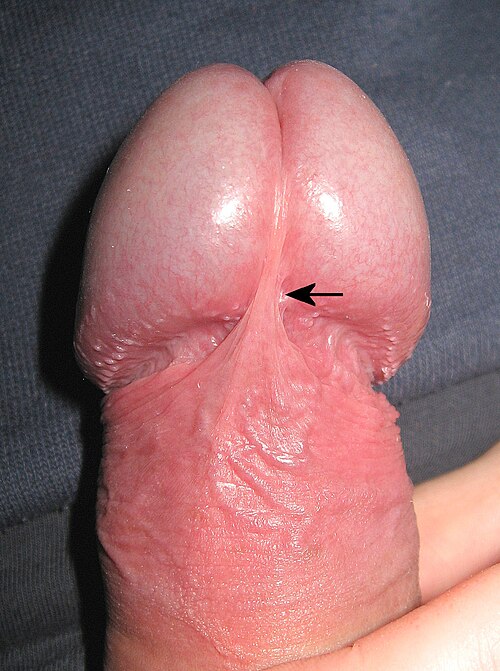

i know many of us had our suspicions by now, but it’s always nice to get a second opinion from people who’ve literally dedicated their entire lives to the study of said things. That little triangle, the frenulum delta, “not only contains a higher density of nerve endings than the glans, but contains a higher concentration of sensory corpuscles, specialised touch receptors made from bundles of nerve endings. Densely clustered in the frenular delta, in the glans, they are isolated and spread out. The sensory corpuscles of the frenular delta include Krause corpuscles, which have previously been found to detect the tiny vibrations that ripple through the genitals when skin rubs against skin and mediate sexual pleasure.”
Nothing like a lovely session touching just that one tiny part of the phallus, a far more mind-blowing experience than one would have imagined. Or a script that’s going for the tip, the machines at just the right angle, and it all goes through the frenulum, oh my Goddess, what a feeling! 
Oh deer, i feel all flush now…!
Think i need a lie down…x

New Scientist, 27 March 2026
Surprising male G-spot found in most detailed study of the penis yet
A long-overlooked area of the penis has been found to have the highest concentration of nerve endings and sensory structures in the organ, suggesting that it is the “male G-spot”
The most detailed neuroanatomical study of the penis to date has found that its primary erogenous zone is the frenular delta, an area that has long been left out of anatomy textbooks and surgical training. The triangular-shaped zone is located on the ventral side, or underside, of the penis, where the head meets the shaft, and may be damaged by circumcision.
“Although this may seem self-evident to anyone attuned to the sensations of their penis during sexual activity, our work scientifically validates the existence of a ventral penile anatomical region that serves as a centre of sexual sensation,” write the authors of the study, led by Alfonso Cepeda-Emiliani at the University of Santiago de Compostela in Spain.
Based on this scientific validation, the frenular delta should be considered the “male G-spot” of the penis, says Eric Chung at the University of Queensland in Australia and president-elect of the International Society for Sexual Medicine, who wasn’t involved in the study. “It is one of the most pleasurable spots for male sexual stimulation.”
Cepeda-Emiliani and his colleagues painstakingly mapped out the sensory nerves in 14 cadaver penises from donors who died between the ages of 45 to 96. To do this, they sliced the penises into fine sections, each just a few micrometres thick, and added special dyes that bound to the nerves. The sections were then examined under a microscope.
In anatomy textbooks and online sex guides, the primary site of male genital sensation is typically said to be the glans, the bulbous head of the penis. But Cepeda-Emiliani’s team found evidence that the frenular delta is more sensitive, since it contains a higher density of nerve endings.
They also discovered that the frenular delta contains the highest concentration of sensory corpuscles, specialised touch receptors made from bundles of nerve endings. These corpuscles are densely clustered in groups of up to 17 in the frenular delta, whereas in the glans, they are isolated and spread out. The sensory corpuscles of the frenular delta include Krause corpuscles, which have previously been found to detect the tiny vibrations that ripple through the genitals when skin rubs against skin and mediate sexual pleasure.
The frenular delta was named by Ken McGrath at Auckland University of Technology in New Zealand in 2001. He called it a delta because of its triangular shape, which sits between the V-shaped wings of the glans on the underside of the penis. At its point is the frenulum, a small bridge of skin that connects the foreskin to the penis. McGrath was the first to call the frenular delta the male G-spot, since it is a pleasure zone reminiscent of the female G-spot, but the terminology didn’t catch on.
The latest study supports the subjective experiences of those for whom stimulation of this so-called G-spot generates “intensely pleasurable and highly specialised sensations”, write Cepeda-Emiliani and his colleagues. The fact that it has attracted so little interest in the past “underscores persistent blind spots in sexual medicine and urology”, they add.
Doctors who perform circumcisions should be educated about the nerve-rich frenular delta because some techniques make incisions across the area to remove the foreskin, they say. This may affect its complex nerve networks and reduce sexual sensations if the incisions are deep and the whole frenulum is removed, rather than leaving some or all of it in place.
Kesley Pedler at Port Macquarie Base Hospital in Australia says she wasn’t taught about the frenular delta and its special nerves during her surgical training. “The frenular delta is not mentioned in the most well-regarded urological surgical anatomy textbooks, even in the most up-to-date editions,” she says. Pedler only performs circumcisions when they are medically necessary, like when the foreskin is too tight, but says that “now we know about this area of nerves, it’s even more important to only do these operations when they’re absolutely indicated”.
Only a small proportion of male babies are electively circumcised in the UK and Australia, but about half undergo the procedure in the US. Whether it alters or dampens sexual sensation later on is controversial.
One large study in Belgium found that uncircumcised men reported more sexual pleasure from stimulation of their frenular delta than circumcised men. On the other hand, a US survey found no difference in orgasm quality between circumcised and uncircumcised individuals, suggesting the circumcised penis may have ways of compensating for any nerve disruption in the frenular delta area.
The female G-spot has also struggled to gain widespread medical acceptance, with some doctors denying its existence. This is because no clear clusters of nerves or sensory corpuscles have been found in its supposed location in cadaver vaginas. But most women surveyed report having an erogenous area a few centimetres inside the vagina along the front wall. Ultrasound studies have revealed that during sexual arousal, the internal part of the nerve-rich clitoris becomes engorged and presses against the vaginal wall, which may explain the sensitive G-spot.
Cepeda-Emiliani and his colleagues say they are now conducting a similar in-depth study of cadaver vaginas and clitorises.