 Introduction
Hello everybody, and welcome back to another one of my guides!
This guide is a follow-up to My Top 5 Onaholes for Interactive Devices. While that guide focused on five specific products that I personally consider good choices, this time I want to take a broader approach.
Instead of telling you which particular Onaholes are suitable, I want to explain what kind of Onaholes are generally suitable for interactive devices — and what characteristics may make them less suitable.
Because an Onahole that works wonderfully during manual use is not automatically a good match for an interactive device. It may feel great in your hands, but once straps, holders, motors, and repeated movement become involved, the situation can change rather quickly.
Device compatibility depends on several different characteristics. Weight and dimensions are certainly important, but they are only part of the equation. An Onahole might appear perfectly suitable when looking at the raw numbers, yet still become unstable during use, bend too much, create excessive resistance, or simply be a small nightmare to secure properly.
In this guide, I will walk you through the most important factors to consider when judging an Onahole for potential device compatibility. The goal is not to create a strict set of universal rules, but to help you better understand what to look for before attaching a new Onahole to your device and hoping for the best.
Let’s take a closer look!
Estimated reading time: 25 – 30 minutes
 Disclaimer & Important Context
Before we get started, there are a few important things to keep in mind.
Compatibility can vary significantly between different devices and setups. Accessories such as holders, straps, adapters, extenders, and alternative mounting methods can all change which Onaholes work — and how well they work.
My own device experience currently includes:
- The Handy 1 and Handy 2
- First-generation FUNSR devices, including the FUNSR1 and FUNSR 2.0
- Second-generation FUNSR devices, including the FUNSR PRO and FUNSR Mini
All observations, recommendations, and examples in this guide are based on my own testing, experience, and current knowledge. Your results may differ depending on your device, accessories, mounting setup, preferred settings, and personal anatomy.
Manufacturer measurements should also be treated as useful reference points rather than perfectly precise guarantees. Small differences in weight, size, material, or production can occur, and those differences may affect how an Onahole behaves once it is attached to a device.
Always stay within the official weight limits, maximum load recommendations, and usage guidelines provided by your device manufacturer. Even when an Onahole can technically be attached and moved by a device, that does not automatically mean the setup will be stable, comfortable, safe for the device, or suitable for longer sessions.
This guide is intended to help you evaluate potential compatibility, but it cannot guarantee that a particular Onahole will work with every device, accessory, or setup.
For transparency, ChatGPT assisted me with formatting and turning my notes into a complete, structured text. However, all experiences, opinions, testing observations, and conclusions presented in this guide are my own.
 Understand the Device First
Before we look at the Onaholes themselves, we first need to talk about an equally important part of the setup: the device.
Different devices have different limitations, holders, mounting options, and safety systems. An Onahole that works perfectly with one device may be difficult — or even impossible — to use properly with another.
Before choosing an Onahole, make sure you understand a few basic characteristics of your device:
- Its recommended maximum load
- Its available stroke length
- The dimensions of its holder
- Whether it supports one or two straps
- The distance between the holder and the device itself
- How securely the device can be mounted during use
These factors determine far more than whether an Onahole can simply be attached. They also affect how stable, reliable, and comfortable the complete setup will be.
 Single Strap or Double Strap?
Whenever possible, I generally recommend using a double-strap system for Onaholes.
Two straps secure the Onahole at separate points, which greatly reduces wobbling, rotating, and unwanted movement. The Onahole stays in position more reliably and is much less likely to slip out of the holder during faster or more intense use.
A single strap can still work, depending on the holder and the Onahole. However, it usually performs best with smaller and lighter products. Once an Onahole becomes longer, wider, heavier, or more irregularly shaped, one strap often struggles to keep everything properly secured.
Technically attached does not always mean securely attached — and discovering that difference at maximum speed is not the most relaxing way to learn.
 The Handy 2 as an Example
The standard single-strap holder of the Handy 2 can work with smaller Onaholes, but it is generally not ideal for medium-sized or larger products. For more serious Onahole use, I strongly recommend the Long Sleeve Holder, which provides a double-strap system and keeps the Onahole considerably more stable.
The Extender is also extremely helpful because it creates more distance between the holder and the device itself.
This is particularly important with the Handy 2. When a larger Onahole sits too close to the device, it may press against or obstruct parts of the mechanism. The Handy 2’s safety system can then interpret this as a blockage and respond by reducing the available stroke length or stopping the movement entirely.
More distance between the holder and the main device gives the Onahole additional clearance and allows it to move more freely. FUNSR devices, for example, naturally provide more space between the holder and the device, so they are less likely to encounter this particular problem.
 Do Not Forget the Mounting Setup
How the device itself is mounted matters as well.
A stable mounting system becomes increasingly important when using heavier Onaholes or higher speeds. If the device can move, tilt, vibrate, or slowly shift out of position, even a perfectly suitable Onahole may perform poorly.
The heavier the Onahole and the more intense the movement, the more force is transferred into the mount. A secure setup helps keep the device aligned, reduces unwanted movement, and makes the entire experience more predictable.
Before asking whether an Onahole is suitable, first make sure you understand what your device and mounting setup can realistically handle.
In other words: know your device before choosing what to attach to it.
 Weight
Let’s begin with weight, as it is one of the most important factors to consider when choosing an Onahole for an interactive device.
The heavier an Onahole becomes, the more force the device needs to move, accelerate, stop, and change direction. Additional weight also places more strain on the motor, holder, straps, and mounting system.
Before attaching anything, always check whether the manufacturer provides an official maximum load recommendation for your device. Staying within that limit is the safest and most reliable approach.
If no official maximum load is available, I recommend starting with a lighter Onahole first. You can then gradually try heavier products while paying close attention to how the device reacts. Reduced speed, unusual noises, shortened movements, excessive vibration, or unstable performance can all indicate that the setup is becoming too demanding.
 My Personal Weight Recommendations
Based on my own experience, I generally recommend staying around the following maximum weights:
- The Handy 1: Approximately 500 g / 1.1 lb
- The Handy 2: Approximately 800–900 g / 1.76–1.98 lb
- First-generation FUNSR devices: Approximately 800–900 g / 1.76–1.98 lb
These are not official manufacturer limits. They are personal recommendations based on what I consider a practical balance between performance, stability, and unnecessary strain on the device.
The newer FUNSR devices are considerably more capable in this regard:
- FUNSR Mini: Official maximum load of 1.5 kg / 3.31 lb
- FUNSR PRO: Official maximum load of 3 kg / 6.61 lb
With those limits, weight is much less likely to become a serious concern during normal Onahole use. Most products will remain comfortably below them, especially in the case of the FUNSR PRO.
To make the different weight ranges easier to understand, I divide Onaholes into three general categories.
 Lightweight Onaholes — Up to Approximately 400 g / 0.88 lb
Lightweight Onaholes are usually the easiest for a device to handle.
The device can move, accelerate, and stop them more easily, while placing comparatively little stress on the motor and mounting system. They are also less likely to overload straps or create aggressive wobbling during faster movements.
This makes lightweight Onaholes a particularly good starting point when:
- you are unsure about your device’s capabilities;
- the manufacturer provides no official load limit;
- you are using a single-strap holder;
- or you are testing a new mounting setup.
The main disadvantage is that lightweight Onaholes are usually smaller and may feel less stable or immersive. They often provide less of that substantial “pressed into your lap” feeling that larger products can create.
They may also move around more easily if they are not secured properly. Light does not automatically mean stable — it simply means the device has less weight to fight against.
Medium-Weight Onaholes — Approximately 400–700 g / 0.88–1.54 lb
Medium-weight Onaholes usually provide the best overall balance between device performance, stability, and immersion.
They are generally large enough to feel more substantial, while still remaining manageable for many interactive devices. Their additional size and weight can create a stronger sensation of the product resting or pressing against your body, without immediately placing excessive demand on the motor.
This is probably the weight category that suits interactive devices best in general.
Medium-weight Onaholes tend to offer:
- better stability than very light products;
- a more immersive feeling;
- enough size for secure double-strap mounting;
- and a manageable load for most modern devices.
Naturally, compatibility still depends on the product’s shape, softness, dimensions, and how securely it can be mounted. However, when all other factors are suitable, this range is often the sweet spot.
 Heavy Onaholes — Above Approximately 700 g / 1.54 lb
Heavy Onaholes can provide the most substantial and immersive experience.
Their larger size and additional weight can create a strong “pressed into your lap” feeling, making the setup feel more solid and physical than a small lightweight sleeve.
However, that extra immersion comes with additional demands.
Heavy Onaholes place more stress on:
- the device motor;
- the holder;
- the straps;
- the device mount;
- and the connection points between all of them.
This may result in reduced performance, slower movement, more vibration, or increased wobbling during fast direction changes.
Depending on the strap system, a heavy Onahole may also gradually shift or loosen during intense movement. A single strap is especially likely to struggle with larger products, as the Onahole can swing or rotate.
A heavy Onahole is therefore not automatically unsuitable, but it requires a capable device and a particularly secure setup.
 Weight Alone Does Not Determine Compatibility
The number on the scale is important, but it never tells the entire story.
For example, a compact and structurally stable Onahole weighing 800 g / 1.76 lb may be easier to secure than a long, extremely soft Onahole weighing only 600 g / 1.32 lb.
The lighter product may bend, swing, twist, or wobble because much of its weight sits farther away from the straps. Meanwhile, the heavier but more compact product may remain close to the holder and move much more predictably.
Weight distribution therefore matters almost as much as total weight.
Not every Onahole is evenly balanced. Certain areas — such as pronounced hips, thighs, buttocks, decorative shapes, or a thicker closed end — may contain considerably more material than the rest of the product.
When most of the weight sits far away from the mounting point, it creates additional leverage. This can make the Onahole feel much heavier to the device than its actual weight might suggest.
A heavier Onahole can still work very well when:
- the weight is distributed evenly;
- the product is compact;
- the straps can hold it securely;
- and the device itself is mounted properly.
So, while weight is one of the first numbers you should check, it should never be the only one.
 Size, Shape & Weight Distribution
Weight gives us an important first impression, but it does not tell us how an Onahole will actually behave once attached to a device.
Its length, width, outer shape, entrance position, and weight distribution all affect how easily it can be placed inside the holder, secured with straps, and kept stable during movement.
Let’s begin with length.
Length and Holder Compatibility
Many Onaholes are approximately 15 cm / 5.91 inches long, although larger products can reach around 20 cm / 7.87 inches or more.
A typical 15 cm Onahole will usually fit more easily into a smaller holder and may work with a single-strap system, depending on its weight and shape.
A 20 cm Onahole requires more support. For products of this length, a larger or longer holder combined with a double-strap system is generally the better choice. Supporting the Onahole at two separate points reduces bending and helps prevent the unsupported end from swinging around during movement.
As a general guideline:
- Shorter Onaholes are easier to use with compact holders and may work with one strap.
- Longer Onaholes benefit from a larger holder and will usually be safer and more stable with two straps.
However, an Onahole can also be too short.
When very little material extends beyond the holder or straps, the Onahole may be more likely to shift or slip out. A short internal canal also increases the chance of bottoming out during a longer stroke, which can quickly become uncomfortable.
That does not mean short Onaholes are completely unsuitable. You simply need to adjust the device accordingly.
For example, I tested the Dress in Secret Onaholes with the Handy 2. These products are only approximately 8.5 cm / 3.35 inches long, making them considerably shorter than a typical Onahole.
By carefully limiting the Handy 2’s stroke range, they can still work surprisingly well.
Device position also matters. Adjusting the height or distance of the device can prevent you from penetrating too deeply and hitting the closed end of the canal.
Speed should be approached carefully as well. A very short Onahole is not something I would immediately run at maximum speed and full stroke. Unless an unexpected launch sequence was part of the plan, start slowly and increase the settings only after confirming that everything remains aligned.
When evaluating the length of an Onahole, ask yourself:
- Can the holder support enough of its body?
- Can the straps secure it properly?
- Does the internal canal suit my personal size?
- Can I adjust the device’s stroke range or position if necessary?
- Is enough of the product supported to prevent bending or slipping?
↔️ Width and Outer Diameter
The width or outer diameter of an Onahole is just as important as its length.
A product may have an appropriate weight and length but still be too wide for the holder. If it cannot sit deeply and evenly inside the holder, it may tilt, rotate, or become unstable during use.
This is not merely inconvenient. An Onahole that is only partially supported can shift suddenly during faster movements, making poor holder compatibility a potential safety concern.
The straps must also be long enough to wrap securely around the entire product.
For most medium-sized and larger Onaholes, I have found straps measuring approximately 30 cm / 11.81 inches to be very useful. They provide enough additional length for wider products without requiring the straps to be stretched or attached at their absolute limit.
Check that the straps:
- wrap fully around the Onahole;
- have enough overlapping Velcro to remain secure;
- do not need to be pulled excessively tight;
- and hold the product firmly against the holder.
If the included straps are too short, replacing them is usually easy. Many third-party Velcro straps work perfectly well, and I use them myself.
A simple strap upgrade can greatly expand the range of Onaholes a holder can support— but longer straps cannot compensate for a holder that is fundamentally too small or poorly shaped for the product.
 Entrance Position and Angle
A small but important detail is the placement and angle of the tunnel entrance.
Many Onaholes have a relatively flat and straight entrance area. These are generally easy to align with a device because the opening points directly toward the user.
However, some products have a tunnel entrance positioned on an incline.
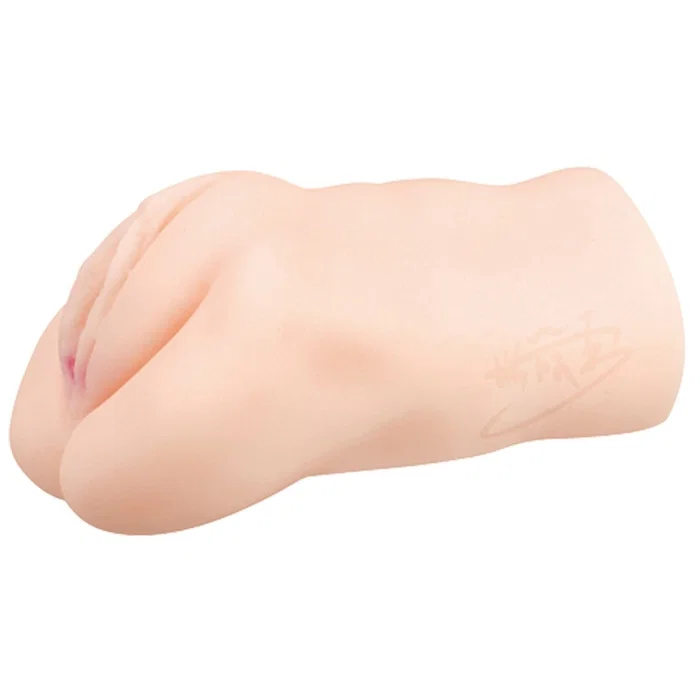
As you can see in this example, the entrance sits at a slight angle rather than facing completely forward. Some Onaholes have an even stronger incline.
An angled entrance does not automatically make an Onahole incompatible, but it requires more attention during setup and use. Depending on your anatomy, position, and mounting angle, it may be easier to slip out of the entrance during a stroke.
When testing an inclined entrance:
- begin with a slow speed and shorter stroke;
- carefully check the alignment;
- adjust the device angle or mounting position where necessary;
- guide or support yourself by hand during the initial test;
- and stop immediately if the movement feels unstable or unsafe.
A larger, rounded, and forward-facing entrance is usually more forgiving. A narrow or strongly angled opening leaves less room for alignment errors.
 Shape and Structural Balance
The easiest Onahole shape to use with a device is generally a traditional cylindrical or oval design.
These shapes sit evenly inside most holders and give straps broad, consistent surfaces to grip. Their weight also tends to remain relatively close to the centre of the holder, helping them move predictably.
Not every Onahole follows this standard shape, however.
Some products have areas that are much more pronounced than others. One side may contain significantly more material, or the entrance area may be much wider and heavier than the upper body.
Rika is a good example.
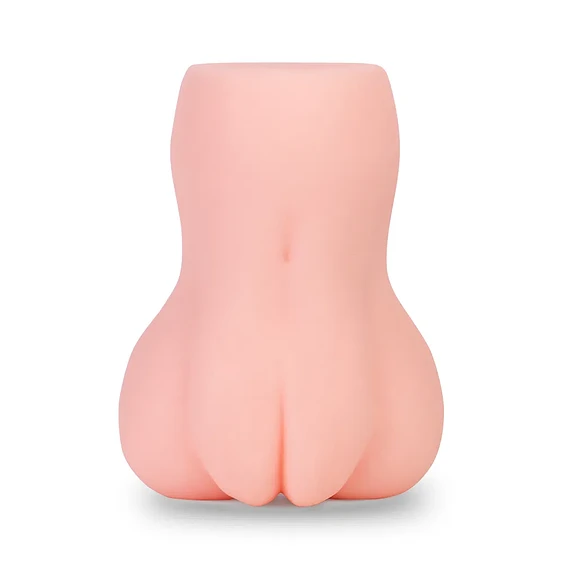
Her butt and entrance area are considerably more pronounced than the rest of the Onahole, meaning much of her weight sits near the bottom. This gives the product a somewhat uneven shape and weight distribution.
Despite that, I frequently use Rika with interactive devices.
The important part is securing the narrower upper area properly so the heavier lower section cannot pull the product downward. With careful double-strap placement, the setup remains stable and works very well.
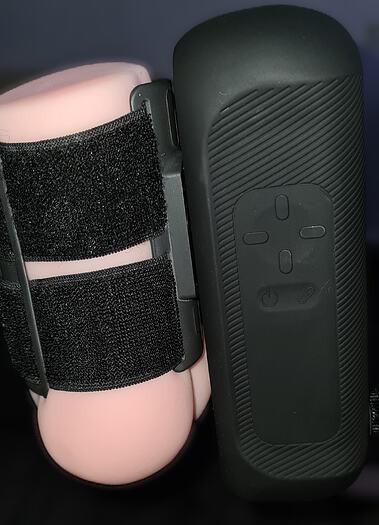
This is a good example of why an unusual shape does not automatically mean poor compatibility. It simply means you need to understand where the weight sits and secure the product accordingly.
 Tapered Onaholes
Tapered products such as the Otokonoko can also work with interactive devices.
Their wider body can usually be secured effectively, but the smaller or more pointed entrance area requires additional attention. Because the usable entrance is narrower and surrounded by less material, slipping out may happen more easily than with a large, rounded entrance.
As with an inclined opening, begin slowly and make sure the device is aligned correctly before increasing the speed or stroke length.
The product may be securely attached to the holder while the entrance itself is still poorly aligned with your body. Both sides of the setup need to match.
 Overly Irregular Shapes
The more irregular an Onahole becomes, the harder it usually is to mount securely.
This includes products with:
- exaggerated curves;
- strongly uneven surfaces;
- attached breasts or other protruding features;
- large differences between the upper and lower width;
- miniature torso shapes;
- or very little flat surface for the holder and straps.
The Slut Angel is an example I often use when discussing this problem.
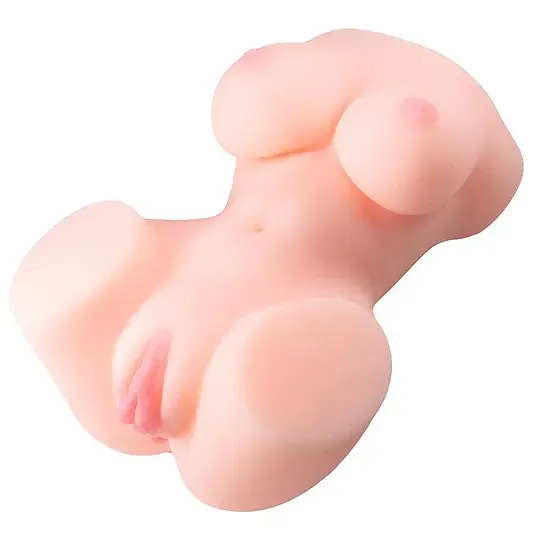
Because it is shaped like a miniature torso, it does not sit naturally inside a typical Onahole holder. The holder struggles to support it evenly, and the straps do not have suitable areas where they can securely pull the product into position.
Trying to tighten the straps around whichever area happens to be available may heavily deform the product without actually making it stable.
That does not necessarily mean every unusually shaped Onahole is impossible to use. As the Rika example shows, some can work very well. However, they generally require more effort, more careful experimentation, and potentially additional accessories such as:
- longer straps;
- a larger or longer holder;
- additional support points;
- or a different mounting position.
Observe How the Onahole Behaves
Once an Onahole is attached, do not judge the setup only while the device is stationary.
Watch how the product behaves during actual movement.
Ask yourself:
- Does the Onahole deform excessively?
- Does it bend or fold during direction changes?
- Does it rotate inside the holder?
- Do the straps remain securely attached?
- Does the holder keep the Onahole properly supported?
- Does the product begin to wobble at higher speeds?
- Does the heavier end pull the setup in one direction?
- Does everything remain aligned throughout the full stroke?
Begin slowly and gradually increase the speed and stroke length. A setup that appears perfectly secure while stationary may behave very differently once several hundred grams of soft material begin changing direction repeatedly.
Size, shape, and weight distribution always need to be considered together.
A standard cylindrical Onahole will usually be the easiest option, while uneven or highly detailed products may require more experimentation. They can still work — but the device needs to hold the Onahole securely, not merely cling to it with determination and optimism.
 Tightness & Internal Resistance
Tightness and internal resistance are factors that many people may not immediately consider when choosing an Onahole for an interactive device.
An Onahole may have the right weight, dimensions, and outer shape, but still create problems if the device has to work against too much resistance during every stroke.
 The “Push-Back Effect”
With particularly tight Onaholes, you may notice what I like to call the push-back effect.
When using the full canal length, the Onahole begins to resist the movement and feels as though it is pushing back against you. During manual use, this usually means you need to apply additional force to continue moving through the canal.
An interactive device has to overcome that same resistance repeatedly.
This can make movement feel less smooth and may cause the Onahole, holder, device, or your body to shift out of position. In more extreme cases, the resistance may contribute to a slip-out, especially when combined with higher speeds or poor alignment.
The Handy 2 is particularly relevant here because its built-in safety system may react when the movement encounters too much resistance. A very tight Onahole can cause the device to interpret the additional force as an obstruction, resulting in reduced movement or the device stopping entirely.
 Otokonoko as an Example
The Otokonoko is a good example of an Onahole that creates this push-back effect.
It is relatively tight, and once you use more of its internal length, the resistance becomes increasingly noticeable. Because of this, I personally do not use it with the Handy 2.
It works considerably better with the first-generation Handy and FUNSR devices. In my experience, these devices are less sensitive to the additional resistance and continue moving through the canal without triggering the same type of safety response.
However, the fact that a device can push through the resistance does not mean you should stop paying attention.
Tight Onaholes can still increase the risk of slipping out, pulling the device out of alignment, or creating unstable movement. Begin slowly, use a reduced stroke range where necessary, and make sure the setup remains secure before increasing the intensity.
 Lubrication Makes a Difference
Lubrication has a major influence on internal resistance.
From my experience, a more liquid lubricant usually provides better and more consistent gliding during automated movement. It spreads through the canal more easily and can reduce some of the friction the device needs to overcome.
This can result in:
- smoother movement;
- less drag;
- more consistent strokes;
- and reduced strain on the device and mounting system.
However, lubrication cannot completely compensate for an Onahole that is fundamentally too tight.
Additional or thinner lubricant may improve the situation, but it does not guarantee compatibility. If the canal strongly compresses around you or creates significant resistance throughout the full stroke, the device may continue to struggle regardless of how generously you apply the lube.
More lubricant also means a greater chance of it reaching the outside of the Onahole, straps, or holder. Once those surfaces become slippery, mounting stability can quickly become a different problem.
↔️ Wider and Tighter Onaholes
In general, Onaholes with a somewhat wider or less restrictive canal are easier to use with interactive devices.
They create less resistance, allowing the device to move more fluidly and consistently. They are also less likely to pull aggressively against the holder or trigger resistance-related safety mechanisms.
That does not mean tight Onaholes cannot work.
They may perform perfectly well when:
- the device can handle the resistance;
- the product is securely mounted;
- enough lubrication is used;
- the stroke range is adjusted correctly;
- and the speed is increased gradually.
The important point is to consider not only whether an Onahole feels tight, but how that tightness behaves across the full canal length.
A moderately tight entrance may not create any problems, while a canal that becomes increasingly restrictive toward the end may produce a strong push-back effect during deeper strokes.
So, when testing a tight Onahole, do not immediately jump to full length and maximum speed. Give the device — and yourself — a chance to determine whether the resistance remains manageable.
Tightness can provide excellent stimulation, but the device should move the Onahole smoothly rather than entering into a small mechanical argument with it during every stroke.
 Softness, Firmness & Structural Stability
Softness does not only influence how an Onahole feels internally. It also affects how easily the product fits into a holder, how securely the straps can grip it, and how predictably it behaves during repeated movement.
Both very soft and firmer Onaholes can work extremely well with interactive devices. As with everything else in this guide, however, compatibility depends on how softness interacts with the product’s weight, dimensions, shape, and internal resistance.
Let’s look at both sides separately.
 Very Soft Onaholes
One of the main advantages of a very soft Onahole is its flexibility.
Soft material adapts easily to the shape of a holder and can often be compressed slightly to fit into spaces where a firmer product might struggle. Provided the overall dimensions are suitable, this can make very soft Onaholes surprisingly versatile across different holders and mounting systems.
Their internal textures also tend to feel smoother and less aggressive. This can create a comfortable and balanced experience with less risk of overstimulation, particularly during longer sessions or when using higher device speeds.
Very soft Onaholes may therefore be especially suitable if you prefer:
- smoother textures;
- longer sessions;
- faster repeated movement;
- less aggressive stimulation;
- or a more relaxed overall experience.
However, their softness can also make them more difficult to control.
Because the material provides very little structural support, the Onahole may wobble, bend, or shift during movement. This becomes more noticeable with longer products, higher speeds, and uneven weight distribution.
Strapping can also be more difficult than expected.
The straps do not have a firm surface to grip, so they may compress the material rather than securely holding the complete product in place. If the straps are too loose, the Onahole may gradually slide out. If they are excessively tight, they may heavily deform the body without necessarily improving stability.
Very soft products can therefore feel a little like trying to strap down an enthusiastic jelly dessert: technically possible, but placement matters.
A double-strap system is particularly helpful here. Supporting the Onahole at two separate points reduces wobbling and makes it less likely to fold, rotate, or slip free during direction changes.
The other potential disadvantage is personal preference. If you enjoy firm pressure and highly pronounced internal structures, a very soft Onahole may feel too gentle or underwhelming, even when it performs perfectly well mechanically.
Advantages of Very Soft Onaholes
- They adapt easily to different holder shapes.
- They can be compressed slightly when space is limited.
- Their textures are often smoother and more comfortable.
- They are well suited to longer sessions.
- They may remain comfortable at higher speeds.
- They generally create a more balanced and less overwhelming experience.
Possible Disadvantages
- They may wobble, bend, or fold during movement.
- They can be harder to strap securely.
- Straps may compress the material instead of gripping it.
- They may gradually slide out if poorly secured.
- Their softer textures may feel too mild for some users.
Firmer Onaholes
Firmer Onaholes generally provide more structural stability.
They retain their shape more effectively inside the holder and give the straps a solid surface to grip. This usually makes their movement easier to predict, especially during faster strokes and sudden changes in direction.
They are less likely to bend, fold, or wobble excessively, which can make the entire setup feel more stable and secure.
Firmer material may also create stronger pressure and make internal textures feel more pronounced. For users who prefer intense stimulation, this can produce a more direct and powerful experience.
Their advantages often include:
- easier and more consistent mounting;
- less wobbling and deformation;
- more predictable movement;
- stronger structural support;
- and firmer, more noticeable stimulation.
The trade-off is that firmer material is less adaptable.
If the Onahole is slightly too wide or shaped poorly for the holder, it may not compress enough to fit properly. A very soft product might settle into the same holder with little effort, while a firm one simply refuses to cooperate.
Firmer Onaholes can also create more internal resistance. Combined with a tight canal or highly pronounced texture, this makes the device work harder during each stroke.
At higher speeds, strong pressure and firmer textures may also become uncomfortable or overwhelming. A texture that feels excellent during slower movement can become much more aggressive when repeated rapidly by a device.
Advantages of Firmer Onaholes
- They retain their shape inside the holder.
- Straps can usually grip them more securely.
- They wobble and deform less during movement.
- Their behaviour is easier to predict.
- They often feel more stable and secure.
- Their textures may provide stronger and more intense stimulation.
Possible Disadvantages
- They cannot adapt as easily to smaller holders.
- They may not fit if their dimensions are slightly too large.
- They can create greater internal resistance.
- They may place more strain on the device.
- Their textures can become uncomfortable at higher speeds.
- They may feel too intense during longer sessions.
Finding the Right Balance
The ideal device Onahole usually sits somewhere between both extremes.
It should be soft enough to remain comfortable and adapt to the holder, but firm enough to keep its shape and move predictably. In other words, you want flexibility without turning the setup into a wobbling mass, and stability without making every stroke feel like the device is fighting through solid rubber.
Very soft Onaholes can work wonderfully, especially for longer sessions and higher speeds. They simply require careful strapping and enough support to prevent excessive movement.
Firmer Onaholes can be easier to mount and more stable, but you should pay closer attention to holder dimensions, internal resistance, and stimulation intensity.
Neither category is automatically better.
The best choice depends on:
- your preferred intensity;
- the size and design of the holder;
- the quality of the strap system;
- the power of the device;
- the selected speed and stroke range;
- and how the Onahole behaves once movement begins.
A product does not need to be perfectly medium-soft to work. It simply needs enough structural stability to remain secure and enough flexibility to stay comfortable throughout the session.
Practical Testing Before Full Use
If you are new to using Onaholes with interactive devices, performing a small compatibility test before actual use is always a good idea.
Even with more experience, I still recommend doing this whenever you are unsure whether a new Onahole will fit the holder properly or remain stable during movement.
A short dry test can reveal problems with the holder, straps, shape, weight distribution, or device clearance before those problems become considerably more inconvenient.
Step 1: Mount the Onahole
Begin by attaching the Onahole while the device is still turned off.
Check whether:
- the Onahole sits properly inside the holder;
- the holder supports enough of its body;
- one strap is sufficient or a second strap is needed;
- the straps are long enough;
- the straps have enough secure overlap;
- and the Onahole remains in place without immediately shifting or sliding out.
Gently move the Onahole by hand. It should feel securely supported rather than loosely balanced inside the holder.
Also pay attention to how much the straps deform the material. Some compression is normal, especially with very soft Onaholes, but the product should not be heavily crushed or folded simply to keep it attached.
 Step 2: Begin the Dry Test
Once the Onahole appears securely mounted, activate the device at a slow speed and with a reduced stroke range.
Observe whether:
- the Onahole remains stable during movement;
- the straps stay securely attached;
- the product rotates or shifts inside the holder;
- the unsupported end begins to swing;
- any part of the Onahole collides with the device;
- and the holder or mounting system moves out of position.
Listen to the device as well. Unusual noises, interrupted movement, sudden reductions in stroke length, or repeated stops may indicate that the load or setup is creating a problem.
 Step 3: Gradually Increase the Speed
If everything remains stable at a low speed, slowly increase the intensity.
Do not jump directly from a gentle test to the maximum setting. Increase the speed in stages and observe the same points each time.
Higher speeds create stronger forces during every change in direction. An Onahole that appears perfectly secure during slow movement may begin to wobble, rotate, or pull against the straps once the device accelerates.
This is also where you can assess whether the device itself handles the Onahole properly. Pay attention to:
- reduced performance;
- excessive vibration;
- unstable movement;
- unusual motor sounds;
- movement of the complete device mount;
- or the Onahole gradually working itself loose.
With very soft Onaholes, some wobbling is normal. Keep in mind that this may become less noticeable during actual use because the product receives additional internal support once you are inside it.
However, the Onahole should still remain securely attached during the dry test. Your anatomy should improve stability — not become the only thing preventing the product from leaving the holder.
 Adjust and Test Again
If anything appears unstable, stop the device and adjust the setup.
You may need to:
- reposition the Onahole inside the holder;
- move one or both straps;
- tighten or loosen the straps;
- add a second strap;
- reduce the unsupported length;
- change the device angle;
- or shorten the stroke range.
After making adjustments, repeat the test from a low speed.
Do not continue increasing the intensity while hoping that an unstable setup will somehow correct itself. Interactive devices are very committed workers, but creative problem-solving is generally not part of their programming.
 Begin Actual Use Slowly
Once the dry test is successful, begin actual use carefully.
I recommend starting with slow manual controls or gentle movement rather than immediately loading the most intense script you can find.
Begin with:
- a slow speed;
- a short or moderate stroke range;
- careful alignment;
- and easy access to the stop controls.
Gradually increase the speed and stroke length only after confirming that the Onahole remains secure and comfortable during actual use.
This is particularly important with:
- very short Onaholes;
- tight canals;
- inclined or narrow entrances;
- heavy products;
- soft and unstable shapes;
- or any setup you have not tested before.
Take safety seriously. A compatibility test only takes a few minutes, while explaining an interactive Onahole incident at the emergency room would probably take considerably longer — and be far less enjoyable.
Start slowly, observe the setup, and increase the intensity only when everything behaves as expected.
 Summary
Choosing an Onahole for an interactive device is not only about checking its weight or measuring whether it fits inside the holder.
A product can look perfectly compatible on paper and still become unstable, create too much resistance, slip inside the straps, collide with the device, or behave unpredictably at higher speeds.
At the same time, an Onahole that initially appears slightly unusual may work extremely well when it is mounted correctly and used with suitable settings.
The following checklists provide a quick overview of the most important signs to look for.
 An Onahole Is Probably Suitable for a Device If…
- Its weight remains within the device’s official maximum load or a sensible range based on experience.
- The device can move, accelerate, and stop it without noticeable performance problems.
- Its length matches both your anatomy and the available stroke range.
- It fits properly inside the holder without being heavily crushed or loosely balanced.
- The holder supports enough of the Onahole’s body.
- One or two straps can secure it firmly without slipping.
- The straps are long enough and have sufficient Velcro overlap.
- Its outer diameter is suitable for the holder.
- Its shape provides stable areas for the holder and straps to grip.
- Its weight is distributed reasonably evenly or close to the mounting point.
- It does not bend, rotate, fold, or wobble excessively during movement.
- Its entrance can be aligned comfortably and safely.
- Its canal does not create excessive resistance or a strong push-back effect.
- The material is soft enough to remain comfortable but firm enough to retain its shape.
- It does not collide with the device throughout the selected stroke range.
- The complete setup remains stable when the speed is gradually increased.
- The device operates normally without unusual noises, sudden stops, or reduced movement.
In practical terms, a suitable Onahole should feel as though the device is comfortably controlling it — not struggling to keep it attached while negotiating with gravity.
 An Onahole Is Probably Unsuitable for a Device If…
- It exceeds the device’s official maximum load.
- The device noticeably slows down, struggles, stops, or reduces its stroke length.
- It is too short for your anatomy or the selected stroke range.
- It is so long that the unsupported section swings or pulls heavily against the holder.
- It is too wide to sit securely inside the holder.
- The straps are too short or provide very little secure overlap.
- The product cannot be attached without being heavily crushed or deformed.
- Its shape offers no suitable surfaces for the holder or straps.
- It has exaggerated curves, protruding features, or an uneven body that prevents secure mounting.
- Most of its weight sits far away from the mounting point.
- It repeatedly rotates, bends, folds, or slides out of position.
- Its entrance is difficult to align or makes slipping out especially likely.
- The canal is so tight that it creates strong resistance throughout the stroke.
- Lubrication does not reduce the resistance to a manageable level.
- It wobbles excessively at moderate or higher speeds.
- It collides with the device, holder, mount, or surrounding surface.
- The setup only remains attached when the straps are tightened excessively.
- You do not feel confident that the setup will remain stable during actual use.
None of these points automatically makes an Onahole impossible to use. Adjusting the stroke range, mounting position, holder, straps, speed, or device angle may solve the problem.
However, if several warning signs appear at the same time, the Onahole is probably not a good match for that particular device or setup.
The Most Important Takeaway
A suitable Onahole is not defined by one perfect measurement.
It is the result of manageable weight, secure mounting, appropriate resistance, sufficient stability, correct alignment, and suitable device settings working together.
The best Onahole for a device is not necessarily the lightest, softest, widest, or most traditionally shaped one. It is the product that remains stable, moves smoothly, feels comfortable, and stays within the realistic capabilities of your complete setup.
When in doubt, mount it carefully, begin slowly, observe how everything behaves, and make adjustments before increasing the intensity.
A few minutes of testing can tell you far more than the product measurements alone.
 Closing Words
Thank you so much for reading!
I hope you found this little guide informative and that it helps you choose an Onahole that fits both your device and your personal preferences.
At first, all the different factors — weight, size, shape, resistance, softness, holder dimensions, straps, alignment — may feel a little overwhelming. However, this is something that becomes much easier with experience.
After testing a few different products, you will quickly develop a feeling for which Onaholes are likely to work well and which ones may become difficult to mount or use safely.
Just remember that compatibility can differ depending on:
- the device;
- the holder and strap system;
- the mounting setup;
- the selected stroke range and speed;
- your personal anatomy;
- and your preferred style of stimulation.
An Onahole that works perfectly for one person may require adjustments for someone else — or may simply not be the right match for their setup.
If you are looking for more specific recommendations, you can also check out my Top 5 Onaholes for Interactive Devices guide, where I share five products that I personally consider particularly suitable for device use.
I would also love to hear about your own experiences.
Which Onaholes do you use with your device? Which combinations have worked especially well for you? Have you found any unexpected products that turned out to be a perfect match — or any that looked promising but became a complete mounting nightmare?
Feel free to join the discussion and share your setups, recommendations, and experiences with the community. I am genuinely curious to see what everyone is using.
And, as always, if you have any questions, please let me know. I am happy to help wherever I can.
Thank you again for reading, and I will see you in the next review, guide, or script!
Hopefully, the next time I write a similar guide, it will be called “Top 5 Hips for Your Interactive Device” — because by then, our devices may finally be strong enough to move them without attempting to escape across the room.
Slibowitz